
“Procrastination is the thief of time.” ~Edward Young~
One of our residents at The Somerset, Marita Burger, wrote:
“Has it ever happened that you set out to do the most important task on your ‘to-do’ list, but instead you wander off doing other things, dusting the bookshelves, browsing social media, liking friends on Facebook, or feeding the cat? Next thing you know, it’s the end of the day, your important task remains unfinished, and your list of uncompleted tasks is longer.
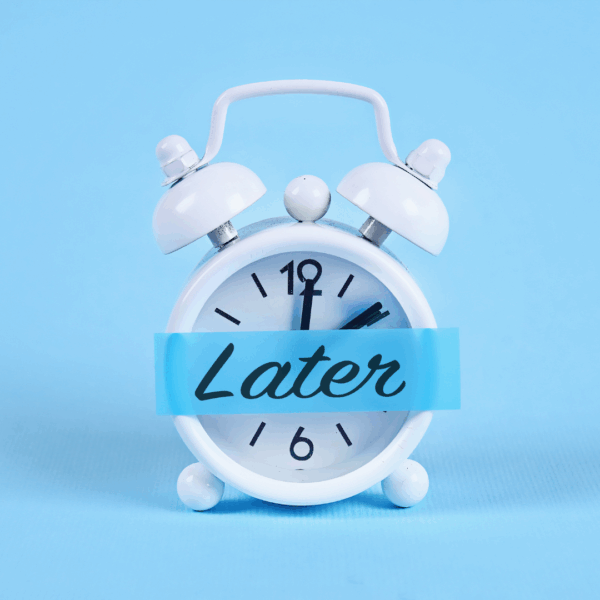
Most of us have been there, right? Procrastinating, the habit of unnecessarily delaying a decision or postponing doing or finishing a task till later. On the bright side, procrastination can sometimes be a blessing in disguise. But it can get tricky when “later” turns into “never,” or when you have to scramble to meet a deadline at the last minute.
I’ve written several pieces over the years on various topics, and I have indeed at times started a piece on procrastination. But every time I did not get further than the first paragraph because a piece on procrastination is certainly the kind of thing you put off. Perhaps due to the belief that there will always be time to revisit this topic.

Now to get started on my analysis of procrastination – which I’ll just put on hold while I get a cup of tea and a rusk – and then have a look at the origin of the word. After all, procrastination is a long word for common usage. In fact, it will take so much effort to say, that I suspect many people even procrastinate about calling themselves procrastinators, chronic procrastinators, master procrastinators.

Seemingly, the word entered the language in the 16th century. It comes from the Latin phrase procrastinationem, which means “a putting off/ putting off till tomorrow.” However, the consequences in the case of ‘to tomorrow’ may not be such a big issue, but when putting it off for weeks, months, and years, it may become a calamity. It may imply waiting for that perfect, magical moment of inspiration to strike, rather than just starting, which can lead to a never-ending state of waiting for the “right” time to do nothing.
But we know that the brain’s pleasure centre is a powerful force. Watching a movie or visiting a friend is easier than tackling a daunting task, so you can immerse yourself in a world of distractions.
What does psychology say about procrastination?
Over time, such a habit will have a destructive effect on our mental and physical health, including stress and low life satisfaction.
But why do we procrastinate? And how can we stop doing it?
The reasons why people procrastinate are not well understood.
| One frequently offered reason is that many of us are perfectionists; we put off making decisions or starting projects because we feel that every choice we make and everything we do must be 100% plus. A person may have a ‘care less’ attitude and believe nothing bad will happen due to a late performance. Others say it is not a matter of being lazy or poor time management, as many smart overachievers who procrastinate often can confirm. They say it may be linked to how our brain works and deeper perceptions of time and the self. Some researchers have viewed procrastination as a lack of self-control, like overeating, gambling problems, or overspending. Furthermore, our motivation, which is based on the expectation of receiving some reward for our efforts, can support our self-control, while hindering factors can be a lack of energy. So, when demotivating and hindering factors outweigh our self-control and motivation, we end up procrastinating. We may tend to avoid time-consuming tasks. It may be due to our personal life situation, including health problems. Avoidance behaviour is a coping mechanism whereby we “give in to feel good”. Lastly, we may just be generally disorganised. Whichever applies, knowing the root cause of why we put off tasks can point to the best way to solve the habit. There are several popular suggestions to overcome procrastination. It is all about finding what works to break the cycle, for example, identifying the currently most important issues. Tackle the task that you regard as the most unpleasant first. Do these tasks first thing in the day when you are at your mental peak. Break the task down into smaller steps and complete the first step today. Try to stop revising as the outcome does not have to be perfect. Disorganised? Start with your workspace – it is easier to focus on priorities when it is organised. Time management? Handle interruptions by putting your phone on silent, scheduling your day (time blocking), and sticking to it. On the other hand, a little delay may be constructive, even healthy. You then tend to complete your tasks, being productive without putting pressure on yourself. That is, instead of charging ahead and making decisions too quickly, sometimes even with impulsivity. Taking more time to start on a task also allows for more creativity. Steve Jobs, an American businessman and founder of the multinational technology corporation Apple Inc., is often quoted as an example of taking short breaks in the middle of a task and going on long walks whenever he felt the need to get creative ideas. “Jobs was a confirmed procrastinator. But putting things off and wasting time did not make him less productive. Instead, it made him more creative.” (Bruce Daisley, a former Twitter exec and author of Eat, Sleep, Work, Repeat. 15 Jan 2025). He believed that constant ‘busyness’ is the enemy of great ideas. It is better to shift from time management to energy management. Although interesting, his way of doing this doesn’t work for everybody or in every situation. |
Another example is Mozart, one of the greatest composers. The understanding of Mozart as a “procrastinator” or a “last-minute” composer comes from hearsay evidence and interpretations of his writing habits. Some say he often worked out compositions in his head and wrote down the final score under pressure (needing the adrenaline?), sometimes even on the morning of a premiere.
The thief of time
A last but fundamental principle. Postponing doing something is detrimental to yourself as well as others. It wastes your time and that of others. Why others? Because we are living in an interconnected world. Whatever we do will always affect others in one way or another. The repercussions of your procrastination will hurt you and cause a ripple effect on the situation around you – friends, family, clients, or those dependent on your service to them. That, by itself, makes procrastination a selfish and egotistical attitude that often damages relationships.
In this era where quality is of the essence rather than quantity, we cannot be more prudent than ensuring excellent work. For businesses, quality work does not come by chance. Management needs to put in effort to provide in the agreed time in order to build their profile in terms of quality and creative performance instead of focusing on meetings galore and colourful websites but substandard service performance. There are no shortcuts to this.
When quality matters, procrastination is not a smart choice.
Life is too short to be anything but happy. Take care.”